Dota's oldest bargain: What match-fixing really costs


Four days before The International 2026 begins, one of its brightest young stars will no longer be there.
Santiago Olivos “TaiLung” Agüero Gustavo was supposed to be one of the stories to watch. At just 17 years old, the young Peruvian midlaner had been steadily turning heads, earning comparisons to some of the greatest prodigies Dota 2 has ever seen. There were whispers of SumaiL, of Miracle-, of that rare sort of player who arrives before the scene has quite figured out what to do with him. Now wearing the LGD banner and preparing to make his debut on Dota's biggest stage, TaiLung seemed poised at the beginning of something.
Instead, days before The International, LGD announced that the organization had received information concerning TaiLung and matters of competitive integrity. The club launched an internal investigation, reported its findings to the relevant tournament organizers and continued cooperating with their investigation.
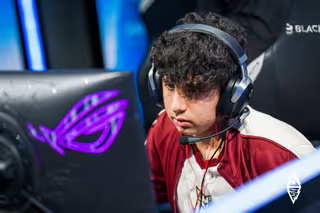

The result was swift —TaiLung will not compete at The International 2026, PGL has permanently banned him from participating in any of its tournaments.
Neither LGD nor the tournament organizers have publicly identified the specific competitive-integrity violation involved. Within the professional Dota scene, however, allegations of match-fixing have circulated openly. Until further information is officially released, match-fixing remains an allegation rather than a confirmed finding.
But the conversation that followed TaiLung's removal was painfully familiar. Because Dota has been here before...far too many times.
The ugly truth is no one wins
Nine years ago, I wrote a piece about match-fixing in Dota 2.
At the time, the scene was still reckoning with the fallout from several high-profile cases. Players from teams such as Arrow Gaming had already found themselves banned from Valve events. Solo's infamous $322 bet had given Dota an enduring piece of vocabulary, one that would eventually become so embedded in the culture that “322” stopped needing an explanation.


I spoke with players who had been caught in it. One of them was ztok.
He had been permanently banned from Valve events following the Americas match-fixing scandal involving Ewolves vs Infamous. When we spoke, he still hoped there might eventually be another chance. He had tried to register for Team Archon but there was no clean way back.
At the time I wrote that players involved in match-fixing were gambling with far more than the money changing hands. Their integrity, credibility, reputation and future were all sitting on the table beside it.
Nine years later, perhaps the strangest thing about rereading those words is how little needs changing. The names and touranments are different and the professional ecosystem surrounding Dota is almost unrecognizable from the one that existed then, and yet here we are again.
In fact, we do not even need to reach nine years into Dota's past to find another version of this conversation. We barely need to reach back a month.
In July, South American team PTime saw its Esports World Cup run come to an abrupt end after midlaner Oswaldo "DarkMago" Herrera and coach Juan "Vintage" Angulo were provisionally suspended by the Esports Integrity Commission amid an ongoing competitive-integrity investigation. ESIC cited suspected breaches of its Anti-Corruption Code and Player Code of Conduct, although it stressed that the suspensions were precautionary and that no final determination of guilt had been made.
PTime ultimately forfeited its series and was eliminated from the tournament. And now, less than a month later, another Peruvian midlaner sits at the center of another competitive-integrity story, this time days before The International.
The cases are separate, the circumstances are different and neither should be treated as evidence against South American Dota as a whole. But their proximity is difficult to ignore. For a region that has spent years fighting for greater recognition, opportunities and respect on Dota's biggest stages, two integrity controversies involving some of its most recognizable talent in the space of a month leave damage that extends far beyond the names under investigation.

Why risk everything?
This is perhaps the question that frustrates fans most whenever another case emerges.
Why?
Why would someone capable of playing professional Dota risk the career they spent years building for a bet? Why would someone with the possibility of reaching The International put that possibility on the line?
From the outside, the math seems absurd, but match-fixing has never existed in a vacuum.
Professional esports careers begin frighteningly young. Some players enter competitive environments at 14, 15 or 16 years old. They can find themselves navigating contracts, prize money, organizations, betting markets and people eager to profit from their success long before most people their age have had to make comparable financial decisions.
Further down the competitive ladder, things become even murkier. Salaries can be small, inconsistent or nonexistent. Careers are short, organizations come and go, tournament opportunities disappear, and prize money is never guaranteed.
And surrounding all of it is gambling. Betting has become so intertwined with esports that it no longer feels entirely separate from the competition itself. Odds sit beside matches and betting companies sponsor broadcasts, tournaments and teams. Players and fans are surrounded by it.
Most will never cross the line, but if we want to understand why match-fixing continues to exist after more than a decade of bans and destroyed careers, simply concluding that the people who do it are greedy or stupid does very little to prevent the next case. Understanding something is not the same as excusing it. And sometimes the path toward that line is far darker than greed.
When gambling stops being a game
A few years ago, another story I extensively covered forced the Dota community to confront that reality.
Taiga had competed at the very highest levels of professional Dota, including with OG, but behind the games visible to everyone else was an increasingly destructive battle with gambling addiction.
He spoke openly about losing enormous amounts of money, isolation, damaged relationships, and about his mental state deteriorating as gambling consumed more of his life. Eventually, he sought help.
His story complicated an uncomfortable conversation esports often prefers to keep simple. There are people who manipulate matches because they want money. There are people approached when they are financially vulnerable. There are players pulled into gambling, people drowning in debts, and people willing to exploit all of them.
None of those realities make match-fixing acceptable. They do, however, tell us that punishment can only ever address part of the problem. By the time a player's name appears on a permanent ban list, something has already gone catastrophically wrong.
The thing match-fixing really steals
The obvious victim of match-fixing is competitive integrity. Competitive sport operates on an incredibly simple agreement between the people playing and the people watching: We believe you are trying to win.
We can argue about drafts. We can criticize item builds. We can rage about a player walking blindly up a hill without vision. We can watch someone miss a spell at the worst possible moment and wonder how on earth a professional player could make that mistake. But underneath all of those reactions sits the assumption that it was, in fact, a mistake.
Match-fixing poisons that assumption.
Once enough doubt enters a competitive scene, mistakes stop simply being mistakes. A strange death, questionable draft, a missed spell all becomes suspicious.
Dota gives paranoia fertile ground because it is a complicated and chaotic game. Wins and loses turn on tiny decisions. Even the greatest players in the world make mistakes that look inexplicable when viewed from the comfort of a replay. But match-fixing teaches us to look at those moments differently. Suspicion spreads and every poor performance risks being questioned and every mistake invites fingers to be pointed. The damage does not stop with the guilty player, it allows everyone to be subjected to accusations or mistrust.
There are always more victims
A fixed match never belongs only to the person who fixed it. There are four other players sitting beside them, another team sitting across from them, coaches, managers and organizations whose work becomes tangled in someone else's decision.
And sometimes there is an entire region forced to carry the reputation created by a handful of people.
LGD will still compete at The International this week. The remaining players have continued preparing while the organization works through an emergency roster change only days before the biggest tournament of their season. Whatever further details ultimately emerge regarding TaiLung's case, those players did not choose this situation.
Yet they have to play through it and there is something particularly devestating about that.
TaiLung was not merely another player heading to TI. He was one of South America's brightest young prospects, a Peruvian prodigy whose rise offered another glimpse of what the next generation of the region might look like. Now the conversation surrounding him is not about his first TI. It is about competitive integrity. And the other young South American players trying to build careers will inevitably encounter some of the suspicion left behind.
That is another cost that never appears beside the amount of money involved.
After the damage is done
Dota has not ignored match-fixing, Valve and tournament organizers have issued permanent bans.
The scene has produced more cautionary tales than anyone should need. Everyone knows what can happen. And still, it happens. Which means perhaps the question after more than a decade should no longer simply be whether the punishment is severe enough.
Permanent bans may be necessary. Competitive integrity cannot survive without consequences. But punishment is what happens after the match has already been fixed. What happens before? Who teaches a 16-year-old entering professional Dota what to do when someone approaches them with an offer? Who explains how those approaches happen? Where does a player go if they are being pressured? Is there a confidential reporting system they trust? What happens when a young professional develops a gambling problem? Who notices? What financial education do players receive when they suddenly begin earning prize money? What responsibility belongs to organizations. tournament organizers? And what responsibility belongs to a betting industry that has become enormously wealthy while wrapping itself ever tighter around esports?
If our first meaningful intervention comes when someone's name appears in a competitive ruling, we are arriving very late.
For years, esports has become increasingly sophisticated at detecting, investigating and punishing competitive-integrity violations. But it needs to become equally serious about preventing them.
Everything that might have been
Perhaps that is why this latest case has landed so heavily only days before The International. There is something uniquely compelling about a prodigy. When we watch a young player emerge, we are not only watching who they are, we are imagining who they might become.
We watched SumaiL become a TI champion at 16. We watched Miracle- rise from pub games into one of the defining players of his generation. Every few years another name appears and people begin wondering whether they might be next. TaiLung had begun attracting those whispers. There was an entire career waiting.
Perhaps that is the ugliest reality of match-fixing and competitive corruption. What cannot be counted is everything that might have happened afterward.
Nine years ago, I called match-fixing a game in which no one wins. Since then dozens of bans and countless ruined matches and careers later, Dota is still learning the same lesson.
We know the price that is paid, but the tragedy is that somehow, someone is always willing to pay it.