"I never expected it to explode the way it did" – Tim Larkin on composing for Dota 2 and TI

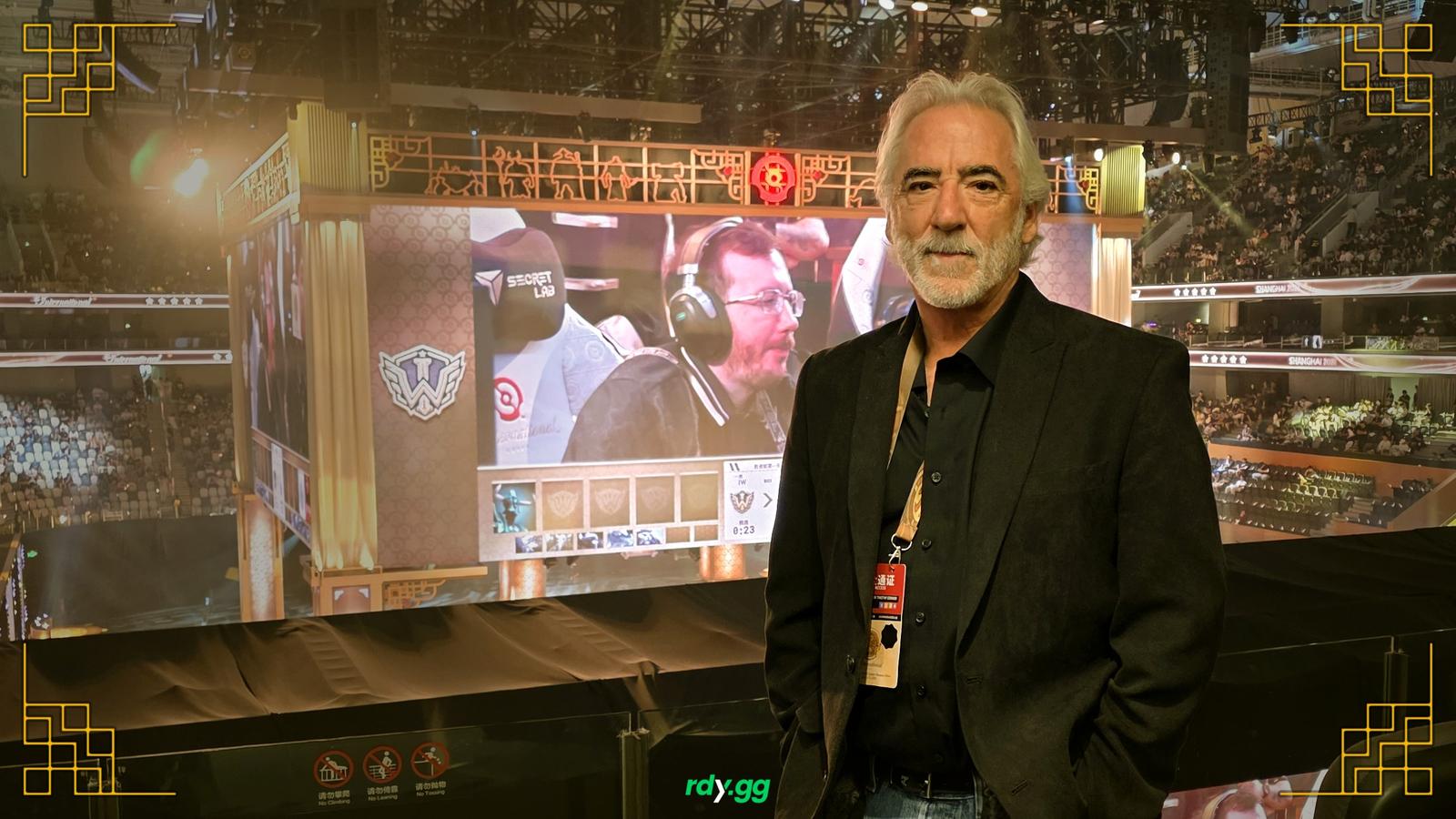
We had the privilege of sitting down with Tim Larkin, the legendary composer and sound designer for Valve, just moments after he conducted the live orchestra at The International 2026 opening ceremony in Shanghai.
Larkin spoke about the evolution of Dota's music, his 15-year journey with The International, 24 years of working with Valve, and what it feels like to see his work performed for millions of fans around the world.
First of all, thank you very much for taking the time to do this.
You're welcome.
So, Mr Tim Larkin, could you introduce yourself to the people who might not know you?
I'm Tim Larkin. I compose the music for Dota 2. Worked with Valve for about 24 years now, so worked on a lot of their games. But the main focus over the last 15-16 years has been Dota, creating Dota music and various content for it.
Can I ask how you got into this industry? 24 years ago, it was a bit of a gamble, right?
Well, actually, I've been doing video game work for longer than that. I actually started doing video games about 32 years ago, when the industry was just starting, basically the CD-ROM industry and the video game industry. So it was much easier to get work at that time because the industry was exploding, everybody needed content, and studios were popping up all over the place.
So I started working for Broderbund Software, and we just happened to get the job. I was working with a friend of mine, and we started a composing company. We just went through the phone book at the time, and Broderbund was the first one that we looked at. That was a software company. We thought, well, they need music. So we called them up, they hired both of us, and the rest is history.
From a phone call, huh?
From a phone call.
That's crazy.
Which doesn't happen much anymore. It's much more difficult now than it was then.
So you said 24 years and 32 years. That kind of longevity is quite rare. How have you managed to stay active within this industry?
Well, I mean, again, in the very beginning, I was working for a company which did Myst and Riven, and they did Carmen Sandiego. They did various games. And so I worked for them for several years. And so it was easy enough to stay active because they were providing me with jobs. Broderbund was also the publisher for a company called Cyan that made Myst. And I worked on Riven through that company, and then Cyan hired me to work for them. So I went to work for Cyan for about another six or seven years.
And one thing leads to another, you know. There were times when I wasn't working for a company, just freelancing and working for myself. So a lot of the time I spent marketing, talking to people, and you know, trying. Sometimes you spend as much time marketing as you do producing content.
But I mean, the way you stay active is I was lucky that the games that I worked on, for example, Riven, I did sound design on Riven, and that was a triple-A title. It got a lot of publicity, a lot of exposure, and that enabled me to get a lot more work because it was such a high-profile game.
Fortunately, I mean, I've done nothing but work on triple-A titles since then because of that. And one leads to another, and if you get it into a cycle of working on high-profile titles, it's much easier to get the next job. I mean, I think that's probably the same in most industries.
photo courtesy of Valve
That makes a lot of sense. So how did you start working with Valve?
I was working at Cyan at the time, working on a Myst online game, and a guy came down- one of the HR guys came down and said, "You've got to check out this game; it's great." And it happened to be Half Life. And so I said, yeah, that's pretty cool, I really would love to work on that.
So I called someone at Valve and again, that doesn't happen anymore. But I happened to get in touch with a gentleman at Valve and spoke with him several times. He knew my work from Riven and said, "Hey, why don't you come on over, and we'll talk."
Again, I've been very fortunate that the way I've gotten jobs in this industry has been much easier than I think it is for most people. I mean, I just happened to be in the right place at the right time.
It took about a year to actually start working for them because, in the beginning, they didn't want to hire contractors, and I didn't live in Bellevue or Seattle, so I didn't want to become a full-time employee while I was doing other jobs. So, it took a while to actually convince them to hire me as a contractor originally and then as an employee later on.
Did you ever envision how, would you say, legendary, iconic, the Dota 2 OST would become?
No, not at all. When it first started out, I didn't understand the game very well, and it was in its formative stages. I had no idea that The International, for example, would turn into this.
The very first International was, you know, in Germany like 15 years ago, and it was relatively small, but it was huge for gaming because it was, like, the first million-dollar tournament. And so that really exploded after that.
I mean, we started doing The International at Benaroya Hall in Seattle, and then it moved into big arenas, and then we started doing them around the world. And I never expected it to explode the way it did. And to be able to do this, to be able to do live concerts of the music with a 100-piece orchestra, I never expected that.
I think the first recording we did for Dota was for the initial trailer, and we went in and recorded a real orchestra for it. And that to me was like, this is great. You know, we can do this. And it just kept on expanding and expanding.
I also worked on Free to Play, the documentary that we did and also all the True Sights and the content that we do for the hero releases and their videos. So it became this huge, multifaceted game. It's not just a video game; it's an esport. They have tournaments; there are comics that we did the documentary about. There was a spin-off on Netflix. So I mean, it turned into something that I never expected, but I still enjoy doing it. It's a very fun game to work on because of the diversity in it.
photo courtesy of Valve
When you first started composing for Dota, what did you envision or what did you think Dota should sound like?
Well, initially I thought it would be more of an epic, gothic-type, big, epic-sounding score. And for the most part, in the beginning it was, and it still is, especially for something like this [points to the arena], it's gotta be huge. You can't go out there with an acoustic guitar and a singer. That ain't gonna cut it. So I try to keep it, you know, to gauge what we're doing. It has to be a big orchestra, big choir, that type of thing.
But the interesting thing that I like about Dota is, especially through all the Hero releases that we've done over time, is the variation. I've done bluegrass music for one of the heroes that are released. We did the last one, Largo; it was kind of like a little jazz or whatever. And I mean, the variation is what keeps it interesting for me, being able to do this different type of stuff and for the different videos that we put out for game updates or whatever.But initially what attracted me was the variety. You look at the heroes, and it's not like there's continuity in a weird way, but the character and the personality of each one of those heroes is so diverse and so different that it allows you to have the option to do that with the music. That's what really attracted me.
How has Dota's sound changed across the different years? The vision that you had for Dota in 2011, is it the same as in 2026?
Well, I mean, as far as the music is concerned, there are definitely recurring themes and things that I build on for The International every year. I mean, it's kind of based, number one, on where we do it. This year is in Shanghai, China. So there's an Asian theme to the beginning, and also it's the theme of the Great Loom.
So, trying to enter the reason that you saw the Gu Chang instrument to start out with, because we figured it would really fit well with the loom because it kind of looks like it, and it fades into this loom-type atmosphere. So that's why that was written for that instrument. And then obviously keeping an Asian flair until we had the dancers.
This year it was a little bit more groove-oriented as it got into the section for the dancers.
We did another international in Shanghai seven years ago, and that also had an Asian feel to it. We did one several years ago in Seattle, and it was a big cathedral that was being built in augmented reality. And so the music had to sort of support that. So it's always different as far as the themes are concerned, the theme of the overall music, but the themes themselves re-occur just in different ways.
photo courtesy of Valve
What is your favourite piece that you've worked on for Dota?
Well, my favourite was actually for Artifact. The score that I did for Artifact had some great musicians on it. Recorded the members of the Mormon Tabernacle Choir and the Budapest Symphony and Utah Symphony. And that was my favourite score that I've done.
Unfortunately, the game didn't do really well. But since then, we've incorporated the Artefact music into Dota because the games are basically based on the same lore, heroes, and that kind of thing. So we brought a music pack in, and that's why, actually, in this concert, I had some Artifact music in there. One of the artefacts, I tried to sneak it in for this year's TI.
There was a Dota orchestra concert here in Shanghai a few weeks ago. I'm sure you've seen it. When you look at something like this happening, basically thanks to your work, how do you feel about it?
Yeah, it was a thrill that they did that. We actually rehearsed with the orchestra in that hall two nights ago. And that's the same orchestra that was playing here.
It's an honour, you know, to have various variations, I guess, on the theme that people have done, from heavy metal to piano solo stuff or whatever. And they've taken and done their own versions, which, again, is flattering. But I'm just doing what I do, and I appreciate that people like it and that they appreciate it, but there's so much good music out there in games and in film and all that stuff.
For someone to actually sort of hold you in that regard is something I never expected and not sure I deserve. But I'm happy that it happens. I mean, it's a thrill. I think the Shanghai Symphony was talking about possibly doing it again or having more concerts. So I may join them for that later. It's an honour.
You talked about movies. Do you have any references or people that you have thought of as composers?
Well, there are so many. There are so many that have done some incredible scores and not only movie scores, but just classical composers or other game composers. The list is too large, and I would hate to single out any one of them.
Would you have any words to say to people who are moved by your work on Dota or any other game?
You just thank people for listening and appreciating it. And what really moves me is when people come up to me, and they've actually listened to the music. Sometimes people come up to me and talk about specific instances in the music. And that's really special to me because they really listen, they're absorbing it, they're digesting the music. And it's something you don't always have to just play the game for. A lot of people listen to it outside the game. And again, that's really flattering. It's really honouring. I definitely appreciate it.
I mean, look at the audience here, and we couldn't do this, obviously, without the people supporting it. So, every bit of it is appreciated.
Well, Mr. Tim Larkin, thank you very much. You are very humble for someone whose work has impacted so many people's lives.
Yeah, I'm just one of many. I'm just one cog in the wheel, you know.
Thank you very much.
You're quite welcome.